
All insights
Market Insight
Emaldo Market Review June: The Danish Ancillary Services Market
Alasdair Firth
·

Issue 1 | June 2026
About this review
Every month we will publish a short review of the energy market that your battery operates in. We want you to understand what is happening in the market, why it matters, and what it means for your Grid Rewards earnings. This is the first of our Danish market reviews.
What your battery does
Your Emaldo battery works in two ways simultaneously. It works for your home, storing cheap electricity and using it when prices are higher, reducing your energy bills day to day. And it works for Denmark, providing the national grid with something called an ancillary service, the ability to respond in seconds when the grid needs to release or absorb power to stay in balance.
Grid operators pay for this service because a stable grid is essential for every home, school, hospital, and business in Denmark. The revenue from those payments is what funds your Grid Rewards. But your battery is also saving you real money on your electricity bills every single day, and that saving continues regardless of what happens in the ancillary services market.
Understanding Denmark's two bidding zones
Denmark is unique among the countries Emaldo operates in because it is divided into two distinct electricity markets, each with its own grid characteristics, market rules, and ancillary service products. Understanding the difference between them is central to understanding your Grid Rewards.
DK1 is Western Denmark, which operates as part of the Continental European synchronous area and is connected to Germany and the Netherlands. DK2 is Eastern Denmark, which operates as part of the Nordic synchronous area and is connected to Sweden. This is not simply a geographic division; it means the two zones participate in fundamentally different markets, connect to different neighbouring grids, and respond differently to changes in supply and demand.
For DK1, revenues are calculated based on participation in the Day-Ahead market, the Intraday market, FCR, aFRR capacity and energy, and mFRR capacity reservation. For DK2, revenues are calculated based on participation in the Day-Ahead market, the Intraday market, FFR, FCR-N, FCR-D, aFRR capacity and energy, and mFRR capacity reservation.
In practical terms, DK2 has historically had access to a broader range of ancillary service products, reflecting its membership of the Nordic synchronous area alongside Sweden, Norway, and Finland, markets where battery storage participation is more mature. DK1, operating in the Continental European market, has been developing its ancillary services participation more recently.
A country leading Europe's energy transition
Denmark has been at the forefront of renewable energy for decades and the pace of change has accelerated sharply in recent years. Denmark's installed electricity generation capacity reached approximately 16 gigawatts in 2024, dominated by renewable sources, which account for over 80% of total capacity. Wind power forms the backbone, with installed capacity exceeding 7.3 gigawatts as of 2023. Wind turbines produced over 19.4 terawatt hours in 2023, accounting for more than half of Denmark's electricity supply, with the share reaching nearly 60% in recent years.
By the end of 2024, Denmark surpassed 4 gigawatts of installed solar capacity, and the country has set a target of 20 gigawatts of solar by 2030. Solar power produced 11.2% of Danish electricity generation in 2024, the highest share in the Nordic countries.
Denmark is targeting a 57% increase in electricity consumption by 2030, driven by electrification of transport and industry, while simultaneously targeting renewables supplying approximately 97% of all electricity consumption by the same year. The combination of more renewable generation and more electricity demand creates an increasingly urgent need for flexible assets, like batteries, that can absorb and release power quickly to keep the grid in balance.
This need is recognised at the highest level. In 2023, Denmark experienced a record number of hours with negative electricity prices, 281 hours in DK1 and 231 hours in DK2, driven by the continued expansion of renewable energy and particularly large increases in total solar production. Negative prices are the grid's way of signalling that it has too much electricity at a given moment. They are both a symptom of rapid renewable growth and a signal of how important battery storage will become as that growth continues.
How the ancillary services market works in Denmark
The ancillary services market in Denmark is procured and managed by Energinet, the Danish transmission system operator. Like Sweden, the market is structured around a hierarchy of products, each covering a different speed of response and duration.
The fastest, acting product in both zones is FCR (Frequency Containment Reserve), which must respond within 30 seconds to frequency deviations. In DK2, this includes both FCR-N (for normal conditions) and FCR-D (for larger disturbances), reflecting the Nordic market structure. In DK1, FCR operates under the Continental European framework. Beyond FCR sits aFRR (automatic Frequency Restoration Reserve), which restores the grid's frequency setpoint automatically within minutes. Finally, mFRR (manual Frequency Restoration Reserve) provides tertiary balancing within 15 minutes and is manually activated by Energinet.
A significant development took place in October 2024. DK1 launched a local aFRR capacity market and joined PICASSO, the Platform for the International Coordination of Automated Frequency Restoration and Stable System Operation, alongside Germany, Austria, and Czechia on 2 October 2024. This brought DK1 into the same pan-European aFRR energy activation framework that DK2 had already been participating in through the Nordic aFRR capacity market since December 2022.
What has happened to prices: DK1
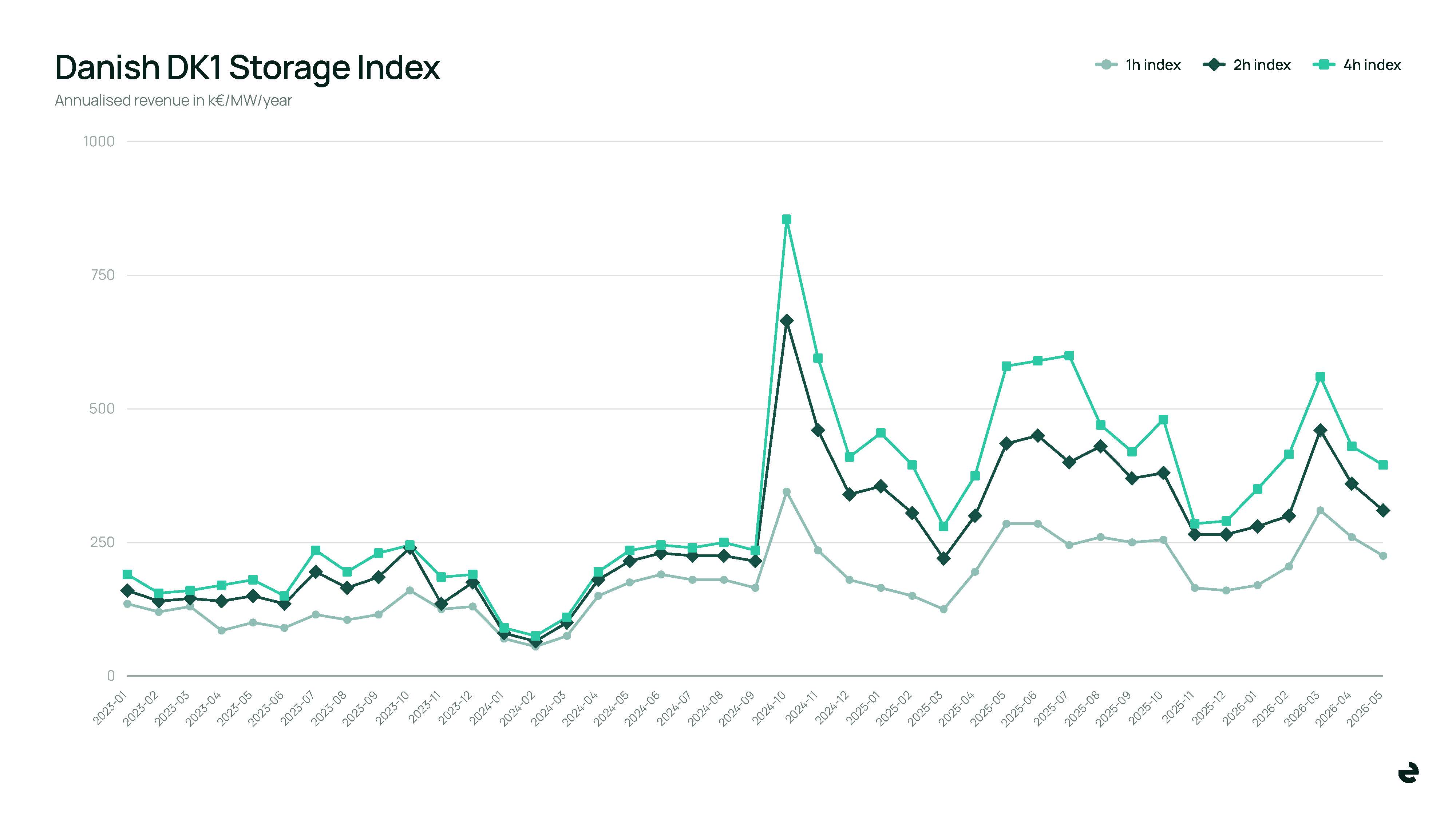
The price story for DK1, shown in the first chart above, is distinct from the dramatic peaks and troughs seen in Sweden or DK2. DK1 has been building its ancillary services market more gradually, and revenues were relatively modest and stable through 2023 and into 2024, generally in the range of 100 to 250 kEUR per MW per year for a four hour asset.
The most significant movement in DK1 came in late 2024, when a sharp spike in aFRR prices followed the launch of the new aFRR capacity market and the connection to PICASSO. This spike was a market liquidity effect, a new product with few initial participants, where limited supply quickly drove prices higher. The largest reserve capacity market in 2023 was the aFRR market in DK1, in which Energinet purchased reserve capacity for 55.5 million kroner.
In Denmark's DK1 bidding zone, revenues from aFRR and mFRR capacity markets declined during May 2026 as competition among storage assets increased. As more batteries and other flexible assets have pre qualified for these markets, the same supply driven price pressure that compressed revenues in Sweden's FCR markets has begun to emerge in DK1. The index shows a broadly declining trend from the late 2024 peak back toward the 150 to 300 kEUR range as the market finds its new normal.
What has happened to prices: DK2
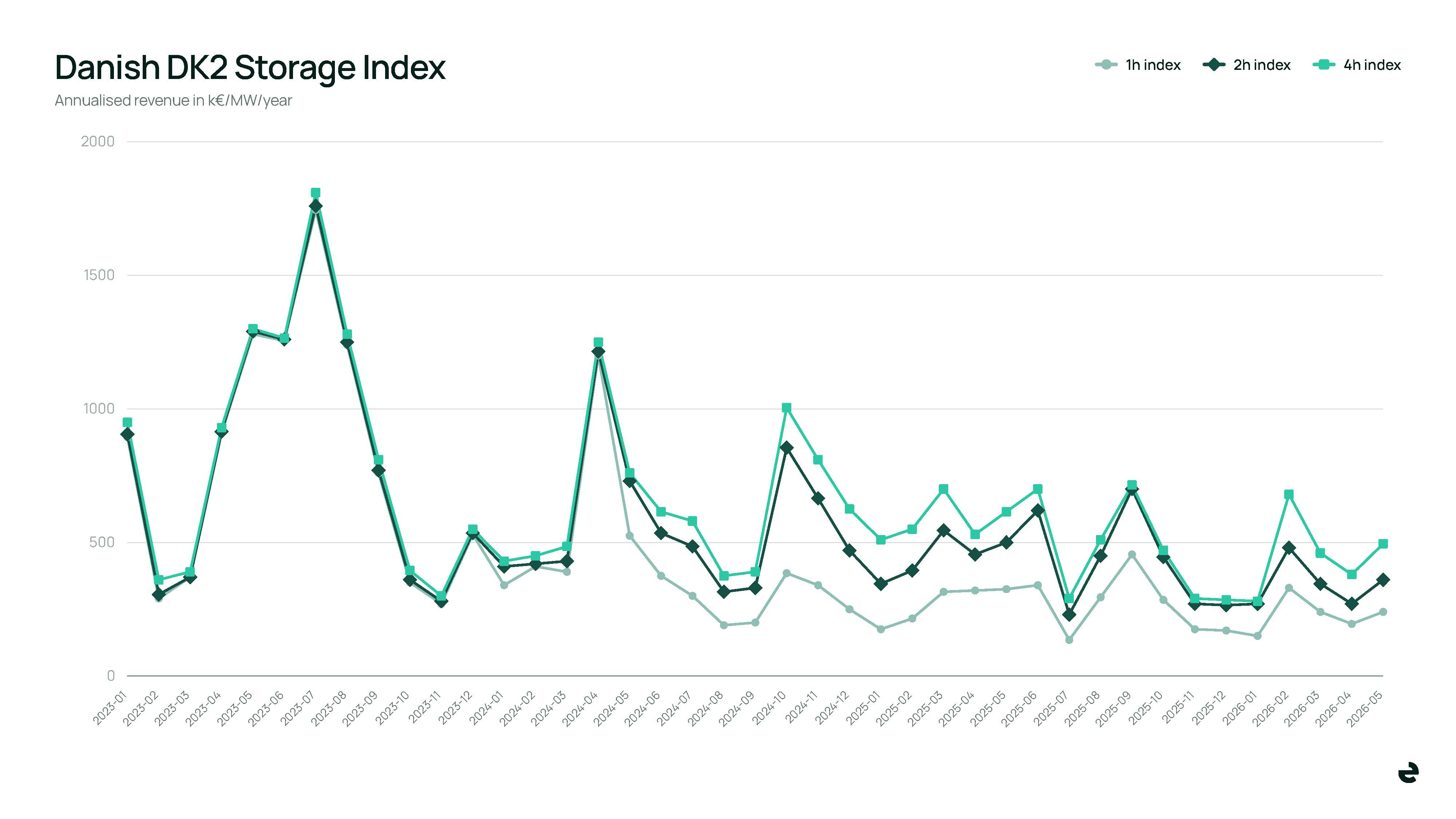
DK2 tells a more dramatic story, and one that closely echoes what happened in Sweden. As part of the Nordic synchronous area, DK2 has had access to FCR-D and the Nordic aFRR capacity market for longer, and the early revenue potential was significantly higher. The Clean Horizon index for DK2 peaked at close to 1,800 kEUR per MW per year for a four hour asset in mid,2023, comparable to the Swedish peak at the same time.
Since then the pattern has been familiar. As battery capacity pre qualifying for FCR-D and the Nordic aFRR market grew rapidly, supply began to outpace what Energinet needed to procure. Prices fell sharply through the second half of 2023 and into 2024, before recovering briefly in late 2024 as the new aFRR energy market launched and the PICASSO connection brought a fresh source of volatility and price opportunity.
A good example of the kind of extreme pricing that the new aFRR energy market can generate came on 2 February 2025, when a 45 megawatt upward activation of aFRR in DK2 resulted in a price of 2,100 EUR per megawatt hour. A deficit in renewable generation, particularly a lack of wind, drove the local PICASSO merit order to extreme levels. This was made worse by DK2 being a relatively small bidding zone, with a limited number of assets available to provide upward aFRR reserves.
Such spikes, while significant when they occur, are by their nature infrequent. In DK2, stronger intraday market performance partially offset declines in aFRR and mFRR capacity market revenues during May 2026. The overall trajectory for DK2 revenues has been downward from the 2023 peak, with the index settling in a range broadly between 200 and 600 kEUR per MW per year through 2025 and into 2026, significantly lower than the heights of 2023, though with more volatility than DK1.
Why DK1 and DK2 behave differently
The two zones' different price histories reflect their different grid structures and market memberships. DK2's connection to the Nordic synchronous area meant it had access to more established and more lucrative products like FCR-D earlier, and also experienced the battery driven saturation of those markets earlier. DK1's connection to the Continental European grid gave it a different set of products and a different development timeline, with its most significant market changes arriving in late 2024 with the PICASSO connection.
Both zones are now converging on a similar market dynamic: more assets competing for broadly stable procurement volumes, which puts downward pressure on capacity prices. The intraday and day ahead energy markets are playing an increasingly important role in both zones as capacity revenues moderate, rewarding batteries that can respond quickly to real time price signals driven by wind variability and demand fluctuations.
The broader picture
The pattern playing out in Denmark is the same one that has already run its course in Sweden and is visible across European battery markets more broadly. A period of high ancillary service prices attracted rapid deployment of new battery capacity. That new capacity saturated the available market volumes. Prices fell as a result. This is a natural and expected consequence of market maturity, the same progression has played out in every European market that has developed battery storage at scale.
Denmark's grid will increasingly need flexible assets as its ambition to reach 97% renewable electricity by 2030 becomes reality. The IEA expects Denmark's total renewable electricity capacity to almost double over the 2022 to 2027 period, driven by offshore wind additions and accelerated solar deployment. More renewable generation means more intermittency and more need for the balancing services that batteries provide. The structural case for battery storage in Denmark remains strong.
What this means for your earnings
As ancillary service prices have fallen across both Danish bidding zones, the revenue available to fund Grid Rewards has reduced in turn. The trajectory differs between DK1 and DK2, DK2 customers experienced higher earnings earlier and a sharper fall, while DK1 customers have seen a more gradual market develop with more modest but more stable revenues. In both cases, customers are likely to notice lower Grid Rewards earnings in the coming months as payments reflect current market conditions.
It is worth remembering that your battery continues to create real financial value for your home every day through energy cost savings, buying electricity cheaply, avoiding peak prices, and making the most of any solar generation. In a market where electricity prices remain elevated and continue to rise, that day to day saving is a consistent and meaningful benefit that sits alongside whatever the ancillary services market delivers.
Emaldo continues to work to access the best available markets across both bidding zones and to optimise what your battery can earn on your behalf as the Danish market evolves.
Guaranteed Grid Rewards plan in Denmark
We have made the difficult decision to temporarily pause new sign-ups to the Guarantee Grid Rewards plan in Denmark.
As our Danish market review explains, both DK1 and DK2 have experienced significant price volatility in recent periods, with ancillary service revenues moving considerably in both directions as the market has developed. This level of unpredictability makes it very difficult to forecast what the market will generate over a three-year period with the confidence required to offer a fixed guaranteed payment. Rather than make a commitment we cannot be certain of honouring at the right level, we believe it is more important to be straightforward with you about where the market currently stands.
This is a temporary decision, and not one we have taken lightly. The Guarantee plan is something we are proud to offer and we are actively working towards reintroducing it for new customers in Denmark as soon as market conditions provide the stability and predictability we need. We will keep you updated as things develop.
Existing Guarantee plan customers are not affected and will continue to receive their guaranteed payments as normal. The Flexible Grid Rewards plan remains fully available, and your battery will continue earning on your behalf in the meantime.
Next month
In our next review we will cover the latest price movements across FCR, aFRR, and mFRR in DK1 and DK2 for the month of June, and what they mean for the months ahead.
Price data referenced in this review is sourced from the Clean Horizon Battery Storage Index (cleanhorizon.com/battery,index), Energinet's published market data (energinet.dk), and the Danish Utility Regulator's annual market reports (forsyningstilsynet.dk).