
All insights
Market Insight
Emaldo Market Review June: The Finnish Ancillary Services Market
Alasdair Firth
·

Issue 1 | June 2026
About this review
Every month we will publish a short review of the energy market that your battery operates in. We want you to understand what is happening in the market, why it matters, and what it means for your Grid Rewards earnings. This is the first of our Finnish market reviews.
What your battery does
Your Emaldo battery works in two ways simultaneously. It works for your home, storing cheap electricity and using it when prices are higher, reducing your energy bills day to day. And it works for Finland, providing the national grid with something called an ancillary service, the ability to respond in seconds when the grid needs to release or absorb power to stay in balance.
Grid operators pay for this service because a stable grid is essential for every home, school, hospital, and business in Finland. The revenue from those payments is what funds your Grid Rewards. But your battery is also saving you real money on your electricity bills every single day, and that saving continues regardless of what happens in the ancillary services market.
Finland's extraordinary energy transformation
Finland's electricity system has undergone a remarkable transformation in a very short space of time, and understanding that transformation is central to understanding the ancillary services market.
Wind power capacity in Finland more than tripled between 2020 and 2024. In 2024, Finland covered 24% of its annual electricity demand with wind power, which represented 25% of domestic production. Wind capacity was up 20% from the previous year, and wind production grew by 37%. In 2024, wind power surpassed hydropower to become Finland's second largest source of electricity behind only nuclear power.
Solar power has followed an even steeper growth curve. Large-scale solar construction began in Finland in 2024 and developed rapidly. The year 2025 marked a record for solar construction, with 227 megawatts of new capacity completed and total capacity more than doubling. With new projects completed at the start of 2026, the combined capacity of wind and solar in Finland surpassed 10 gigawatts, three times the total capacity of Finland's hydropower and equivalent to roughly 6 to 10 large nuclear reactor units.
In 2024, 95% of Finland's electricity production came from fossil-free sources: nuclear, wind, hydro, solar, and renewable fuels. This is a genuinely extraordinary achievement for a country that was still heavily reliant on fossil fuels and Russian electricity imports less than a decade ago.
Wind and solar power comprised 19% of Finland's electricity production in 2023 and are projected to supply over 50% by 2030. However, due to the intermittent nature of these sources, Finland is estimated to remain electricity-negative for 61% of hours in 2030, with an annual deficit of 10 terawatt-hours. This is the defining challenge that makes batteries increasingly important and increasingly valuable to Finland's grid.
Why Finland needs batteries
As wind and solar take a larger share of Finland's electricity mix, the grid faces a fundamental challenge. Wind turbines only generate when the wind blows. Solar panels only work when the sun shines. Finland shows one of the highest numbers of hours with negative electricity prices in Europe, with 754 hours in a recent twelve-month period, the second highest in Europe. Negative prices are the grid's signal that it has too much electricity at a given moment, typically because renewable output has surged beyond what the system needs. They are both a symptom of rapid renewable growth and a sign of how important fast-acting flexible assets will become as that growth continues
The need for reserve capacities in Finland is expected to grow by 134% within the next five years, according to Fingrid. Whereas hydropower historically provided most ancillary services, the transition towards wind and solar has increased the need for fast-acting services. Fingrid is actively encouraging new participants to enter the market, developing the technical systems of the ancillary markets to be more compatible with different types of technologies, and lowering the minimum bid from 5 megawatts to 1 megawatt.
Batteries are uniquely suited to meeting this need. They respond in fractions of a second, absorb surplus power instantly, and release it just as quickly when there is a shortfall. No other technology matches this combination of speed and flexibility, and as Finland's renewable capacity continues to grow, the structural case for battery storage only strengthens.
How the ancillary services market works in Finland
The Finnish ancillary services market is procured and managed by Fingrid, the national transmission system operator. Finland is part of the Nordic synchronous area alongside Sweden, Norway, and the eastern Danish zone DK2, which means it shares some common market frameworks with its neighbours while also operating its own national products.
In Finland, revenues from battery storage are calculated based on participation in the Day-Ahead market, the Intraday market, FFR, FCR-N, FCR-D, aFRR capacity and energy, and mFRR capacity reservation and energy activation markets. This is one of the broadest available product ranges of any European market, reflecting both the maturity of the Nordic ancillary services framework and Fingrid's active efforts to develop new balancing mechanisms.
The products range from the ultra-fast to the relatively slow. Fast Frequency Reserve (FFR), introduced across the Nordics in 2020, requires a response within one second and was designed specifically to address the loss of inertia that comes from replacing large conventional power plants with wind and solar. Frequency Containment Reserves cover FCR-D for disturbances and FCR-N for normal operation, each responding within 10 seconds. Automatic Frequency Restoration Reserve (aFRR) restores the system frequency within 5 minutes. Manual Frequency Restoration Reserve (mFRR) provides tertiary balancing within 15 minutes and is activated manually by Fingrid.
A battery asset in Finland would historically earn its baseline revenues, equal to 70 to 90% of its total, from frequency reserve services, primarily FCR-N. The final composition of the revenue stack depends on the asset manager's trading strategy, but Finnish batteries typically provide fast frequency services when prices and volumes are high and frequency containment reserves the rest of the time.
Emaldo's participation in the Finnish market We are pleased to share that in May 2026, Emaldo received official approval from Fingrid to participate directly in the Finnish ancillary services markets. This is a significant milestone for us and for our Finnish customers, as it marks the formal recognition of Emaldo as an approved participant in one of Europe's most developed battery balancing markets. Today we participate in the Finnish market through our trusted partner CheckWatt, and we look forward to building on this foundation as the market continues to evolve. This approval strengthens our ability to access the best available products on your behalf and positions us well to respond as market conditions develop in the months and years ahead.
Two significant market developments in 2024 and 2025
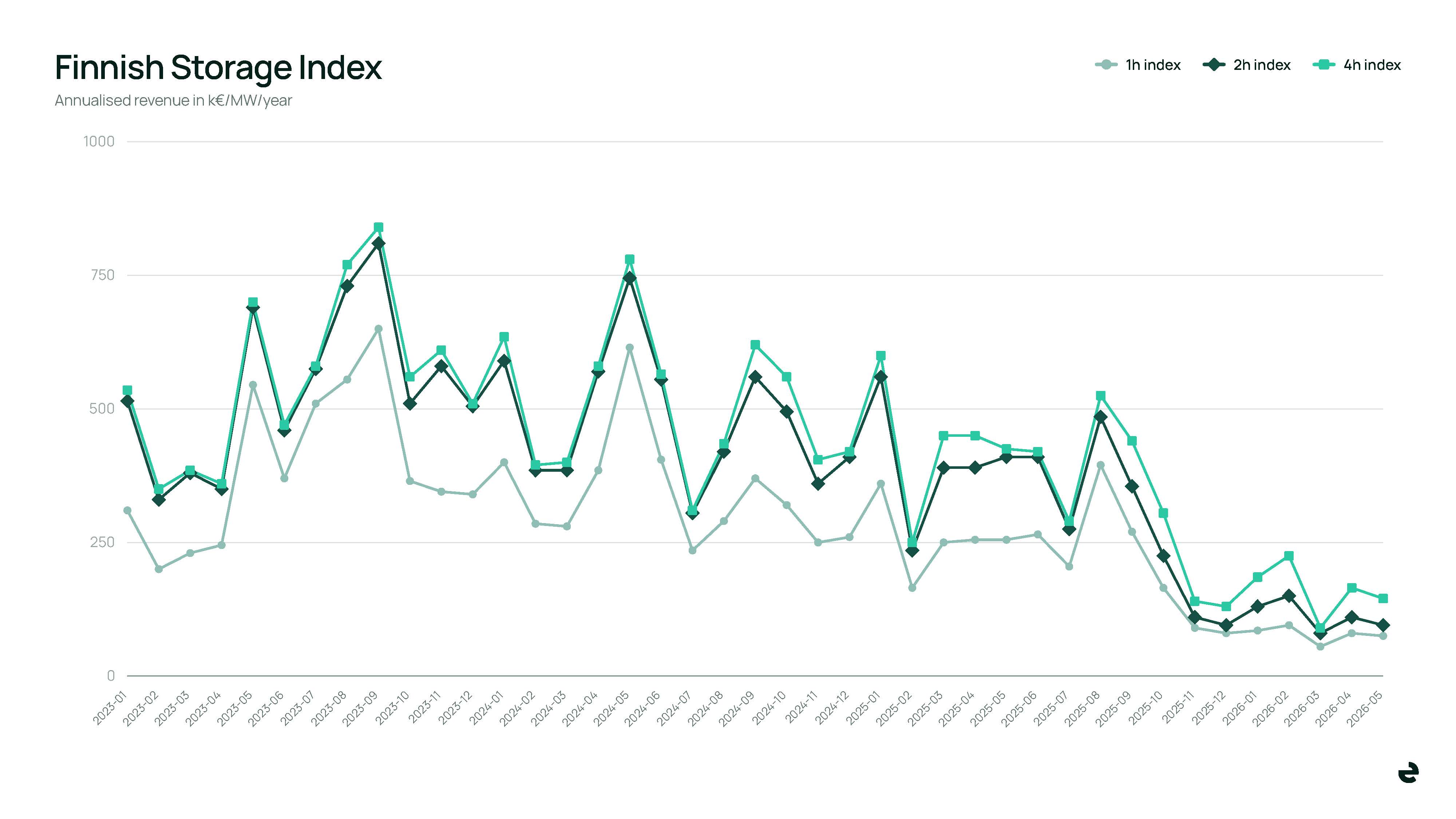
Finland's ancillary services market went through two important structural changes in quick succession that are directly relevant to understanding the price chart above.
In June 2024, Fingrid launched a local aFRR energy market, a real-time market where battery operators bid to provide automatic frequency restoration energy at 4-second intervals. This was a significant development, opening a new revenue stream and preparing the market for Finland's connection to PICASSO. The price of aFRR energy is determined for each 4-second market period by a real-time activation signal based on aFRR energy market bids, and the bid validity period is 15 minutes.
Finland then joined PICASSO, the pan-European platform for aFRR energy activation, in March 2025. The transition to a 15-minute clearing time for mFRR energy provision in March 2025 led to increased volatility, with an average daily spread of 836 euros per megawatt-hour since the change, and significantly affected imbalance prices, with very low-price events observed on the downward provision side immediately after the switch. Both of these changes can be seen in the price chart, which shows elevated and volatile revenues through much of 2024 and into early 2025 before a sharp decline from the spring of 2025.
What has happened to prices
The Finnish Storage Index from Clean Horizon (cleanhorizon.com/battery-index) shows a market that has moved through several distinct phases since 2023.
Through 2023 and into 2024, revenues were relatively strong and stable, generally in the range of 350 to 850 kEUR per MW per year for a four-hour asset, with periods of higher volatility. According to the Clean Horizon Index, revenues were exceptionally high through much of 2024 and into early 2025, with capacity reservation in the various FCR markets contributing the largest share. The launch of the aFRR energy market in June 2024 and the subsequent PICASSO connection added new sources of revenue and price volatility that temporarily supported elevated earnings.
But from the spring of 2025, the picture changed significantly. Since April 2025, the impact of battery-driven price cannibalisation has become evident in the FCR-N reserve market, where prices have fallen sharply as new battery capacity has entered the market at pace. Over the past year, several major battery storage projects have been commissioned in Finland, and nearly 400 megawatts are currently under construction. The index shows a clear and steep decline from the highs of late 2024 and early 2025 to levels broadly in the range of 100 to 200 kEUR per MW per year by May 2026, a dramatic compression in a very short period of time.
An updated battery development scenario shows a high level of battery penetration across all capacity reservation markets, including aFRR and mFRR, with reservation prices dropping as a consequence. A more conservative approach to long-term ancillary services prices now better reflects the potential risk of low prices in the long term. With lower capacity market prices, batteries are increasingly generating a larger share of their revenues through Day-Ahead and Intraday energy trading.
Why Finland's experience differs slightly from Sweden and Denmark
Compared to Sweden, where the price collapse in FCR-D was rapid and steep from a very high peak in mid-2023, Finland's market followed a somewhat different trajectory. FCR-N has historically been the primary product in Finland rather than FCR-D, and prices of FCR-N and FCR-D upward had been continuously increasing for several years before the recent decline, suggesting that the Finnish market reached saturation later than Sweden's.
The structural reforms of 2024 and 2025, including the aFRR energy market launch, the PICASSO connection, and the transition to 15-minute mFRR clearing, also gave the Finnish market additional revenue sources that temporarily masked the supply-driven price pressure building in the FCR markets. When that pressure became impossible to ignore from April 2025, the fall was sharp.
Finland also has a distinctive feature that distinguishes it from its Nordic neighbours: the 2023 commissioning of the Olkiluoto-3 nuclear reactor, which increased nuclear power generation by over 50% and brought nuclear to a 40% share of Finland's electricity generation in 2024. This large, stable baseload source affects the overall grid balance and the frequency and nature of balancing events, which has implications for which ancillary service products are most in demand at any given time.
Where the market goes from here
Looking ahead, after 2026, all primary reserve markets in Finland are expected to be saturated, shifting battery operations from FCR-N towards FCR-D, aFRR, and mFRR procurement. A two-hour system is forecast to generate a third of its revenues on capacity markets in its first years of operation, with the balance shifting progressively towards energy trading.
The need for reserve capacities in Finland is expected to grow by 134% within the next five years, as the energy transition continues to expand the need for fast-acting balancing services. As wind and solar approach 50% of Finland's electricity production by 2030, the grid's requirement for flexible assets to manage intermittency will continue to grow. The structural long-term need for batteries in Finland is not in question. The current period reflects a market working through a rapid influx of new supply, not a weakening of the underlying requirement.
What this means for your earnings
As ancillary service prices have fallen sharply across the Finnish market since the spring of 2025, the revenue available to fund Grid Rewards has reduced in turn. Customers are therefore likely to notice lower Grid Rewards earnings in the coming months, reflecting the current state of the market.
It is worth remembering that your battery continues to create real financial value for your home every day through energy cost savings, buying electricity cheaply, avoiding peak prices, and making the most of any solar generation. In a market where electricity prices can be highly volatile and where negative price periods are among the most frequent in Europe, a battery that stores cheap electricity and uses it at the right time delivers consistent, real savings that sit alongside whatever the ancillary services market delivers.
Emaldo continues to work to access the best available markets and optimise what your battery can earn on your behalf as the Finnish market evolves.
Guaranteed Grid Rewards plan Finland
We have made the difficult decision to temporarily pause new sign-ups to the Guarantee Grid Rewards plan in Finland.
As our Finnish market review explains, the Finnish ancillary services market has undergone significant structural change in 2024 and 2025, with prices falling sharply since the spring of 2025 following a rapid increase in battery storage capacity across the country. This level of price movement makes it very difficult to forecast with confidence what the market will generate over a three-year period, and without that confidence we are not in a position to offer a fixed guaranteed payment that we can stand behind responsibly. We feel it is far better to be open with you about this than to make a commitment at a level that may not reflect market reality.
We want to be clear that reintroducing the Guarantee plan in Finland is a priority for us. It is an important part of what Emaldo offers, and we genuinely look forward to making it available again as soon as market conditions give us the stability and predictability we need to do so. We will keep you informed as the market evolves and as soon as we are in a position to reintroduce it we will let you know.
Existing Guarantee plan customers are not affected by this change and will continue to receive their guaranteed payments as normal. The Flexible Grid Rewards plan remains fully available, and your battery will continue earning on your behalf in the meantime.
Next month
In our next review we will cover the latest price movements across FFR, FCR, aFRR, and mFRR in Finland for the month of June, and what they mean for the months ahead.
Price data referenced in this review is sourced from the Clean Horizon Battery Storage Index (cleanhorizon.com/battery-index) and Fingrid's published ancillary services market data (fingrid.fi).